Tuesday, August 10, 2010

Parting Shots... SATURDAY, JULY 24

   *Sigh* All good things must come to an end, at least in this world—although as my favorite C.S. Lewis book, The Great Divorce postulates, things are going to be different...  After a last big English breakfast this morning we packed and started our good-byes.  I made some new friends this week, and hope to keep those friendships up.  One of the pastors participating for the second time is actually the husband of an old friend who was on staff at my home church in California, so it is likely I will be able to connect with him on visits to my family back there.  The others will take more deliberate effort.
   Chris and Cynthia (the couple whose marriage I performed at the beginning of my sabbatical) came down from Cambridge this afternoon and were able to tour the Kilns, then we spent the afternoon walking around Oxford and rode the train into London together.  They headed back up to Cambridge, where Chris is in a summer program, and I headed to my spartan lodging in the dorms of the City University of London.  The rooms are basic and the shared bathrooms really basic, but they are clean and extremely inexpensive.  No internet, so my postings will be delayed even longer...
  Here are some last photos from the Kilns and Oxford that did not make it in...
  Above is one of the Narnia windows in Lewis' local parish church.  The first below is one of out pub meals; standing at the back in the white shirt is Chesterton scholar Aidan Mackey.  Clockwise from him is Kim Gilnett (CS Lewis Foundation's expert on Lewis and Oxford), one of the neighbors from Lewis Close,  Janice Thompson (puppeteer), Nancy Baker (retired schoolteacher), Rev. Eleanor Kraner, Dr. Den Conneen (emergency room doctor), Rev. Len Tang, and John Allums (lawyer working for ICE).
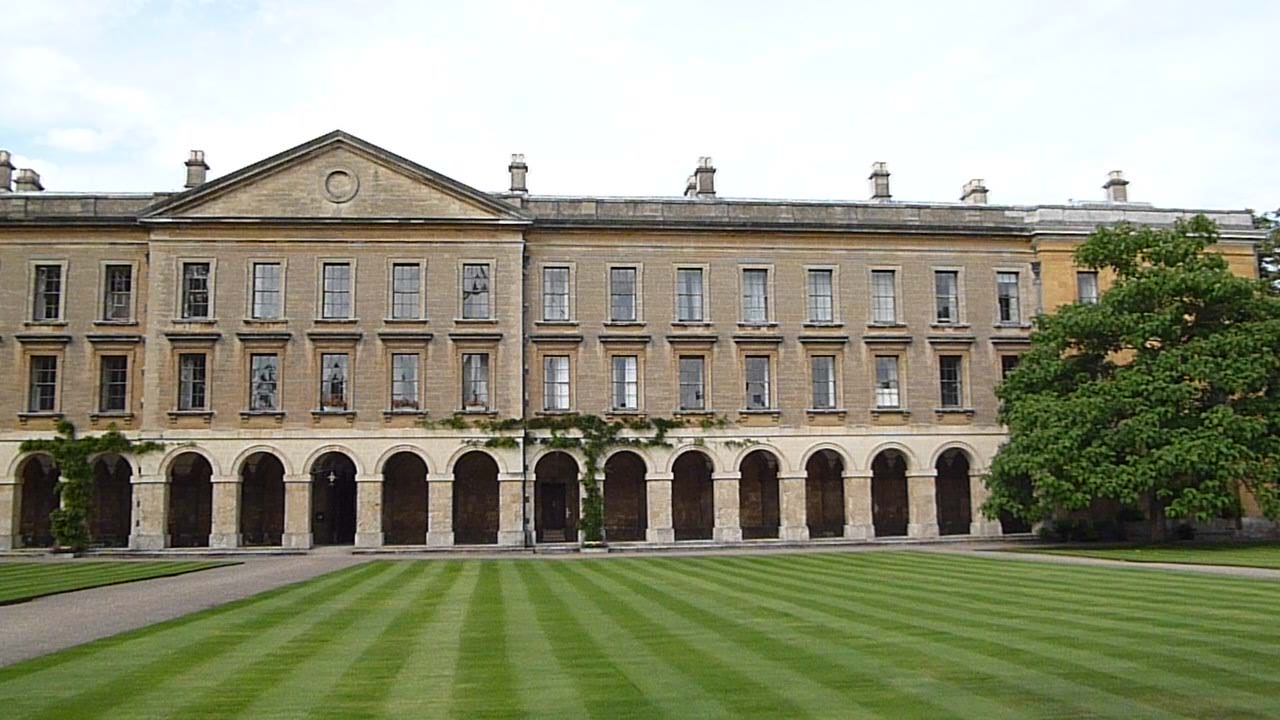
Next is of the building at Magdalen where Lewis' rooms were—on the 2nd floor in the middle of the picture, just above the ivy.  Below that is a doorway at Magdalen, with the shield of the college on the left and the red rose of the House of Lancaster on the right (the college was founded during the Wars of the Roses, when Lancaster was in power).  Next is more deer at Magdalen; then the statue of Aslan in the living room of the Kilns.  The plaque in my room at the Kilns, then Chris taking a picture of Cynthia in Oxford (note the street name).  Last is me writing at the roll-top desk in my room.  Lewis kept a roll-top at the same spot, although this is not the original...


Banquet at the Kilns FRIDAY, JULY 23

   The Wade Center at Wheaton College is an institute founded to study seven authors, four of them members of the Inklings—C.S. Lewis, J.R.R. Tolkien, Owen Barfield (Lewis's close friend and solicitor, the Narnia books were originally written for his daughter Lucy), and Charles Williams.  Two of the others were from the previous generation and heavily influenced Lewis and his friends—George MacDonald and G.K. Chesterton.  The last is Dorothy Sayers, who was at Oxford contemporary with the Inklings and a friend of Lewis and others, but, she was a woman... and it was a different time.  It was unthinkable that a lone woman would meet with a group of men in the back room of a pub even for a reading group.
   Now what does this have to do with a banquet at the Kilns?  Well, the Wade Center's highest honor is the Clyde S. Kilby Lifetime Achievement Award.  It is given to those who have had enormous impact on the study of one of the seven authors listed above, and in the 45 years of the Wade Center's history it has only been given to three people—and two of them joined us for the banquet tonight—Walter Hooper and Aidan Mackey.  Aidan, who is the scholar of all things Chesterton, actually joined us for several days this week, so Walter Hooper was the guest of honor at our end-of-the-week celebration.  Much of the night was spent listening to him tell Lewis stories (one of which I videoed if anyone is interested).  Hooper became Lewis' secretary at the very end of his life, when ill health made it difficult to keep up his letter writing and other work.  After Lewis died Hooper stayed on as the literary executor of his estate and much of the credit for Lewis' ongoing popularity is because of his work keeping the titles in print.  The C.S. Lewis Foundation staff did a terrific job of catering the meal (again, I loved the two courses after dessert) and it was a great way to finish the week.  Hooper's insight into Lewis' last, controversial book—A Grief Observed—was particularly fascinating and 180 degrees different from conventional wisdom.  And as we ate and talked and munched and talked and sipped and talked, hanging over the table was the original Eagle and Child sign which Hooper had rescued from the trash pile.

Sunday, August 8, 2010

Churchill and Blenheim Palace FRIDAY JULY 23

   Blenheim Palace reminds me a lot of Hearst Castle, on the California coast.  Both are monuments to conspicuous consumption, which dwarf the efforts of most of today's plutocrats.  In today's dollars Hearst Castle cost over 500 million dollars to build and furnish;  Blenheim over 500 million pounds, or 1.5 times as much!  Even more remarkable, more than half the cost of Blenheim was a gift from Queen Anne to the first Duke of Marlborough in gratitude for his victory over the army of Louis XIV at Blenheim in southern Germany in 1704.  In a sense Blenheim Palace and its gardens were the British reprisal to the Versailles of Louis XIV.
   Most of the dukes since the first have struggled to maintain the palace and its associated lifestyle.  One sold over a hundred paintings which would have a current value averaging 1.5 million dollars apiece.  Another, the uncle of the palace's most famous resident, married a Vanderbuilt... he needed her family money and the families of the Guilded Age all longed to marry their daughters to dukes and earls and princes (he was all 3).
   That most famous resident was born in the bed below in 1874, and I was ticked when he lost Time magazines competition for most influential person of the 20th century, finishing second to Albert Einstein.  I'm talking about Winston Churchill, of course.  He was born in the palace and spent much of his childhood there with his grandmother, the duchess of that time.  He continued to love it and upon his death chose to be buried in the local churchyard rather than in Westminster Abbey.  Despite his flaws, I have always been fascinated by his towering impact on modern history (not just WW2) and that is why I was eager to see this place.
   I have to admit I was especially impressed by the library, the second longest non-commercial room in England.  Unrecovering bibliophile that I am I have long harbored the blatantly materialistic desire to have a house with a traditional wood-paneled library.  Even a small one, unlike this one which could have contained the Wright Brothers' first flight...
   Today's Duke doesn't have the money problems of his ancestors—the palace more than pays for itself.  As a World Heritage site it attracts tourists by the busload, and adult admission is almost $30.  Today they had a special deal where admission included a card good for a year.  I'd love to get back since an hour-and-a-half barely started us on the interior, let alone the gardens.  Since I probably won't be back, though, the card makes an attractive souvenir :)  The other picture below is the private chapel by the way... I'd love to show the library but most of the interior is off-limits to photography.

The Inklings FRIDAY, JULY 23

   As I was trying to explain to Mr. Beaver, the Inklings were a group of friends who met regularly for literary purposes.  For many years they met at the Eagle and Child (affectionately called the Bird&Baby because of its sign, the original of which Walter Hooper preserved and which now hangs in the library at the Kilns) but when a remodel did away with their private room near the end of his life Lewis led the group across the street to the Lamb and Flag (where incidentally Thomas Hardy did much of his writing, including Jude the Obscure).  Some of the works that had their first reading at the Bird&Baby were Tolkien's Lord of the Rings and Lewis' Out of the Silent Planet.
   The pub is now the place that most C.S. Lewis lovers visit when in Oxford, and luckily it has decent food, especially pies (not dessert pies).  I sampled several at lunch.  A colleague who works at the international hq of IFES (International Fellowship of Evangelical Students, of which InterVarsity is the US member organization) actually was proposed to here...

More of Middle-Earth FRIDAY, JULY 23

   Today was broken into 3 parts:  The Inklings, Blenheim, and a banquet.  So I'm also posting in several pieces.  The picture above is the house that JRR Tolkien lived in while writing The Hobbit and The Lord of the Rings trilogy.  I will let his own words explain the picture below...

          "Among the tales of sorrow and of ruin that come down to us
          from the darkness of those days there are yet some in which
          amid weeping there is joy and under the shadow of death
          light that endures.  And of these histories most fair still in the
          ears of the Elves is the tale of Beren and LĂșthien." 
                           —JRR Tolkien, The Silmarillion Chapter 19


Thursday, August 5, 2010

Peter Pan played Cricket and CS Lewis punted... THURSDAY JULY 22

   One of the buildings LaGard Smith pointed out to us today was in the village of Stanway—which is still a working manor.  He was showing us the use of staddle stones—these are mushroom-shaped stones that were used as the foundations of buildings to keep rats out.  The rats could not climb around the cap of the stone (wonder if this would work on government buildings?)  This particular building was the pavilion on the manor's Cricket pitch, and I was surprised to discover when I googled Stanway tonight that it was a gift from J.M. Barrie [author of Peter Pan], a Cricket-playing guest at the manor in the 1920's.  It is unusual to see these staddle stones holding up a building these days—most of them have become expensive garden ornaments for Cotswold cottages.
   Those of you who are fans Tolkien and a penchant for trivia (like me) might remember that a village in Bree was named Staddle... as we drove home through the quaintly named villages of the Cotswalds I could not help but notice that several of them bore a resemblance to place names in Tolkien's Shire and Bree—and I have to think that this is the countryside that inspired his description of those hobbit lands.  Some of those colorful Cotswold village names we passed included Buckland (where LaGard lives), Chipping Camden and Chipping Norton, Bourton-on-the-Water, Moreton-in-Marsh, Shipston-on-Stour, Wotton-under-Edge, and my favorite, Stow-on-the-Wold.
   When we returned to the Kilns, I took advantage of the remaining daylight to do some exploring in the CS Lewis Nature Preserve that contains the majority of what was the Kilns property.  As you can tell from the old picture I posted earlier this week, the largest pond there once dominated the view from the house, and Lewis used to go punting on it.  His old punt, no longer pondworthy, still sits in the yard.  The pond which was in the open when Lewis bought the Kilns is now in the forest he planted.  And I suspect that his Narnia landscape was at least partly inspired by his walks through his land and over Shotover Hill.
   To see the staddle stones double-click the picture above. Below is the walking path up Shotover Hill, the pond, and the punt in the front yard of the Kilns.

The Heart of England THURSDAY JULY 22

   We spent the day today in the Cotswolds, a range of hills that runs about 90 miles from north to south just a little west of Oxford.  They are called "The Heart of England", because of their natural beauty and the fact that most of the countryside has remained rural, rustic, and well... quaint.  Most of the buildings are built of the native stone, which is bright yellow-orange when first quarried but over the years fades to a mellow dun color.  And since most of the buildings are at least 75 years old (and some much older) they are all that oddly pleasing hue.  The many small villages—each built around a manor and its farm—have mostly remained outwardly the same.  The many wealthy people who have purchased cottages as second homes have upgraded the interiors, though.  This includes some Americans, but you are more likely to spot British celebrities in the local pubs.  It's a desired honeymoon location as well.
   We were visiting LaGard Smith, Law professor, author, and consultant for the new CS Lewis College that has acquired the old Northfield-Mt. Hermon campus in Massachusetts.  Check out his page at Amazon.com.  Especially note the title on Cotswold meditations...  LaGard took us to lunch at a pub in a nearby village called the Fleece Inn which is over 600 years old--and very little changed.  The room we ate in had a rack displaying a set of pewter—and the display is 300 years old!  Note the 3 circles painted in front of the fireplace in the picture above—they are supposed to prevent witches from coming down the chimney.
   We then wandered from village to village, catching a glimpse of the highest gravity-fed fountain in the world, driving through the midst of lavender fields, and finally ended up back at LaGard's cottage for an incredible 'high tea'.  Lavender scones with whipped honey anyone?
   As you can tell from his book titles, LaGard is an interesting guy—and if you have a million dollars or so that you would like to invest in CS Lewis College he'd probably invite you to come and stay awhile...
The pictures below are the Smiths with part of the High Tea goodies they prepared, and their stone cottage and garden.